The CORSMAL challenge:
Audio-visual object
classification
for human-robot collaboration
Description
The CORSMAL challenge focuses on the estimation of the capacity, dimensions, and mass of
containers, the type, mass, and filling (percentage of the container with content), and the
overall mass of the container and filling. The specific containers and fillings are unknown to
the robot: the only prior is a set of object categories (drinking glasses, cups, food boxes) and
a set of filling types (water, pasta, rice).
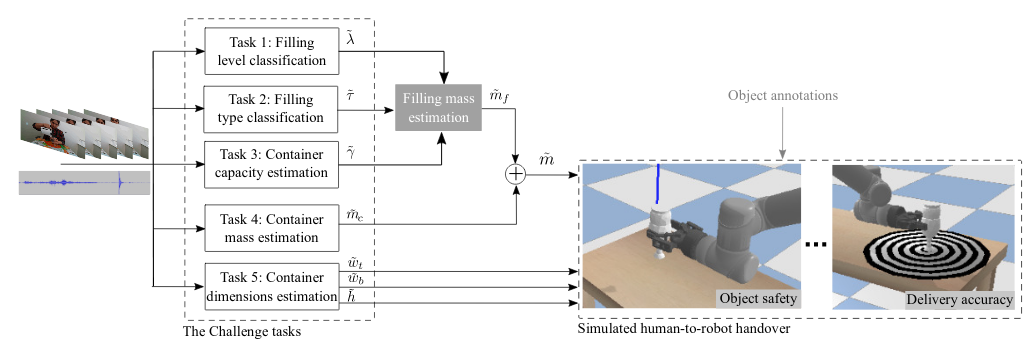
Containers vary in shape and size, and may be empty or filled with an unknown content at 50% or
90% of its capacity.
The tasks are as follows:
-
Task 1 (T1) Filling level classification.
The goal is to classify the
filling level as empty, half full, or full (i.e. 90%) for each configuration
-
Task 2 (T2) Filling type classification.
The goal is to classify the type
of filling, if any, as one of these classes: 0 (no content), 1 (pasta), 2 (rice), 3 (water),
for each configuration.
-
Task 3 (T3) Container capacity estimation.
The goal is to estimate the
capacity of the container for each configuration.
-
Task 4 (T4) Container mass estimation.
The goal is to estimate the mass of
the (empty) container for each configuration.
-
Task 5 (T5) Container dimensions estimation.
The goal is to estimate the
width at the top and at the bottom, and height of the container for each configuration.
The weight of the object is the sum of the mass of the (empty) container and the mass of the
(unknown) filling, multiplied by the gravitational earth acceleration, g=9.81 m/s-2.
We expect methods to estimate the capacity, dimensions, and mass of the container and to
determine the type and amount of filling to estimate the mass of the filling. For each
configuration, we then compute the filling mass using the estimations of filling level from T1,
filling type from T2, and container capacity from T3, and using the prior density of each
filling type per container. The density of pasta and rice is computed from the annotation of the
filling mass, capacity of the container, and filling level for each container. Density of the
water is 1 g/mL. The formula selects the annotated density for a container based on the
estimated filling type.
The challenge uses CORSMAL Containers Manipulation as reference dataset. See the
webpage for more details and download
the data.
Leaderboards
Legend
- View 1: view from the fixed camera on the left side of the manipulator
- View 2: view from the fixed camera on the right side of the manipulator
- View 3: view from the fixed camera mounted on the manipulator (robot)
- View 4: view from the moving camera worn by the demonstrator (human)
- A: audio modality
- RGB: colour data
- D: depth data
- IR: infrared data from narrow-baseline stereo camera
- ZCR: Zero-crossing rate
- MFCC: Mel-frequency cepstrum coefficients
- ZCR: Zero-crossing rate
- A5F: Audio 5 features (MFCC, chromogram, mel-scaled spectrogram, spectral contrast, tonal
centroid)
- kNN: k-Nearest Neighbour classifier
- SVM: Support Vector Machine classifier
- RF: Random Forest classifier
- PCA: Principal component analysis
Combined CCM test sets
Scores update
SWAPPING! Score of container mass: s7 -> s4. Scores
for container dimensions: (s4, s5, s6) -> (s5, s6, s7).
OFFSET!
Scores for object safety (s9) and delivery accuracy (10) do not account for testing
configurations where failures were introduced by the simulator. Both scores have been
also increased equally for all teams by an offset to account for inaccuracies introduced
by the simulator. The value of the offset for each test set (public, private, combined)
is determined as the residual between 100 and the score computed with annotated physical
properties (ground-truth) provided as input to the simulator.
CCM public test set
Scores update
SWAPPING! Score of container mass: s7 -> s4. Scores
for container dimensions: (s4, s5, s6) -> (s5, s6, s7).
OFFSET!
Scores for object safety (s9) and delivery accuracy (10) do not account for testing
configurations where failures were introduced by the simulator. Both scores have been
also increased equally for all teams by an offset to account for inaccuracies introduced
by the simulator. The value of the offset for each test set (public, private, combined)
is determined as the residual between 100 and the score computed with annotated physical
properties (ground-truth) provided as input to the simulator.
CCM private test set
Scores update
SWAPPING! Score of container mass: s7 -> s4. Scores
for container dimensions: (s4, s5, s6) -> (s5, s6, s7).
OFFSET!
Scores for object safety (s9) and delivery accuracy (10) do not account for testing
configurations where failures were introduced by the simulator. Both scores have been
also increased equally for all teams by an offset to account for inaccuracies introduced
by the simulator. The value of the offset for each test set (public, private, combined)
is determined as the residual between 100 and the score computed with annotated physical
properties (ground-truth) provided as input to the simulator.
Filling level classification
Filling type classification
Container capacity estimation
Container mass estimation
Joint filling type and level classification
Container dimensions and capacity estimation
Solutions of the teams
Select a team to see the details
Performance scores
The CORSMAL challenge evaluates and ranks the teams by assigning a 100 point-based score that
accounts for a set of objective performance scores and an assessment of the submitted source
code for reproducibility. The integrity of the submitted results is ensured by having a public
test set with no annotations available to the teams and a private test set with both the data
and the annotations not available to the teams. For the public test set, teams run their models
on their own and submit their results in a constrained amount of time. For the private test set,
organisers will install, run and evaluate the teams' models.
To provide a sufficient granularity into the behaviour of the various components of the
pipeline, we use 10 performance scores for the challenge tasks across public and private sets.
The first 7 scores quantify the accuracy of the estimations for the 5 main tasks. The last 3
scores are an indirect evaluation of the impact of the estimations on the quality of
human-to-robot handover and delivery of the container by the robot. Performance scores will be
also computed individually for the public CCM test set, the private CCM test set, and their
combination. The scores cover filling level, filling type, container capacity, container width
at the top, width at the bottom, and height, container mass, filling mass, object mass
(container + filling), and the delivery of the container upright and at a pre-defined target
location.
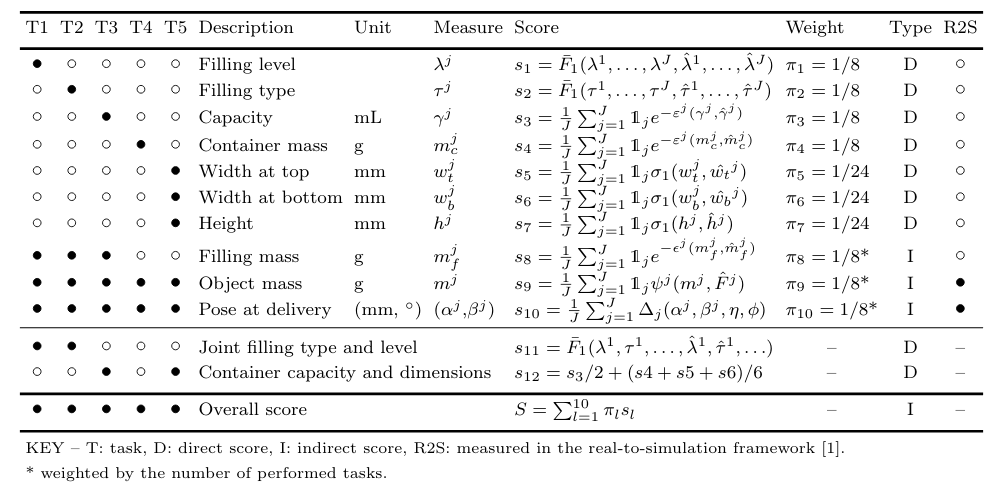
For a measure a, its corresponding ground-truth value is â. The scores are
normalised, and the overall score is in the interval [0,100]. F1 is the
weighted average F1-score. Filling amount and type are sets of classes (no unit).
See the document
for technical details on the performance measures.
The challenge also evaluates and ranks the teams on additional groups of tasks:
-
Joint filling type and level classification. Estimations and annotations of both
filling type and filling level are combined in 7 feasible classes and the weighted average
F1-score is recomputed based on these classes.
-
Container capacity and dimensions estimations We combine the scores for the two tasks
(s3, s4, s5, s6)
with a weighted average, i.e. 1/2 for s3 and 1/6 for s4,
s5, s6.
-
Filling mass estimation. The score for filling mass (s8) is
computed from the estimations of filling type, filling level, and container capacity, and
weighed by the number of tasks performed by the teams (i.e., 0.33 for one task, 0.66 for two
tasks, 1 for the three tasks). The score is not a linear combination of the scores outputted
for filling level classification (Task 1), filling type classification (Task 2), and
container capacity estimation (Task 3), it takes into consideration the formula for
computing the filling mass (see the document for technical details) based on the estimations of
each task for each configuration. This means that a method with lower Task 1, Task 2 and
Task 3 scores can obtain a higher score for filling mass compared to other methods because
the performance on each configuration is more accurate in general. Note that estimations
from the random case are used for the tasks that are not addressed by the teams to compute
the filling mass.
The scores for the three groups of tasks are computed individually for the public CCM test set and
the private CCM test set, as well as their combination.
Rules
Teams
-
Teams, which can include individuals from one or more institutions, must pre-register using
the online form, or via email, and nominate a contact person.
-
Individuals can be team up with other individuals by the organisers, if they wish.
-
All teams will be referred to using codenames (e.g., provided team names during the
registration) in rank order.
-
The organisers are not allowed to participate in the competition.
Solution design and development
-
Teams are free to choose the platform where to develop their own solution, subject to the
requirements that the source code is reproducible, easy-to-install, and easy-to-run by the
organisers during the evaluation stage.
-
Organisers encourage teams to adopt GitHub as hosting platform for software development,
distributed version control using Git, and source code management. Organisers offer to set
up private repositories (one for each team) where the members of a team are added as
contributors to then develop their solution. It is totally up to each team if they want to
choose this solution.
-
Inferences must be generated automatically by a model that uses as input(s) any of the
provided modality or their combination (e.g., images, audio or audio-visual fusion).
Non-automatic manipulation of the testing data (e.g., manual selection of frames) is not
allowed.
-
The use of prior 3D object models is not allowed (e.g., the reconstruced shapes of the
containers in 3D provided for the simulator).
-
The only prior knowledge available to the models is the high-level set of categories of the
containers (cup, drinking glass, food box), the set of filling types (water, rice, and
pasta) and the set of filling levels (empty, half-full, and full).
-
The use of additional training data is allowed (but the provided test set cannot be used for
training).
-
Organisers encourage the teams to officially release any new annotations on the CCM dataset
for reproducibility by the community.
-
Models must perform the estimations for each testing audio-visual recording only using data
from that recording, and the training set; not from other recordings. Learning (e.g., model
fine tuning) across testing recordings is not allowed.
-
Teams will not be allowed to use infrared data.
-
Online solutions - i.e., solutions that can be run on a continuous stream as for the case of
human-to-robot handover - are preferred. To encourage this type of solution, organisers will
refer to the CORSMAL real-to-simulation framework
that allows the participants to observe models would perform for a human-to-robot handover.
Submission guidelines
-
Teams will submit the estimations for each configuration of the CCM public test set as csv
file to corsmal-challenge@qmul.ac.uk.
-
The source code should be properly commented and easy to run. Organisers will provide
guidelines for the software requirements to encourage the teams in using standard virtual
environments and libraries (e.g., Anaconda).
-
Teams will submit the source code of their solution to the organisers who will install and
run the solutions and generate the estimations for each configuration on the private CCM
test set. The organisers will require to input an absolute path to the testing set to
perform the evaluation. Therefore, teams should prepare the source code in such a way that
data path is provided as input argument. Organisers recommend teams to have a single
README file with a brief description; employed hardware, programming language, and
libraries; installation instructions; demo test; running instructions on the testing set;
external links to pre-trained models to download, if any; and licence.
Note that organisers will run the submitted software with the following specifications:
Hardware
- CentOS Linux release 7.7.1908 (server machine)
- Kernel: 3.10.0-1062.el7.x86_64
- GPU: (4) GeForce GTX 1080 Ti
- GPU RAM: 48 GB
- CPU: (2) Xeon(R) Silver 4112 @ 2.60GHz
- RAM: 64 GB
- Cores: 24
Libraries
- Anaconda 3 (conda 4.7.12)
- CUDA 7-10.2
- Miniconda 4.7.12
-
Estimations outputted for each configuration of the public and private test sets by the
teams' algorithms must follow the format of the template provided by the organisers.
Columns related to tasks not addressed by the teams should be filled with -1 values. Method
failures or configurations not addressed should also be filled with -1 values. Filling mass
column can be left empty (all -1 values) as the estimations will be computed automatically
by the evalution toolkit using the estimations from filling level, filling type, and
container capacity columns. The three columns about object safety and delivery accuracy will
be estimated by the organisers when running the simulator using the rest of estimations as
input.
-
When submitting the results of the CCM public test set to the organisers, teams must provide
information about
-
the modalities used,
-
the tasks solved,
-
the complexity of the models (i.e., model storage in MB, number of trainable
parameters, network architecture specifications in terms of number of convolutional
layers, etc.),
-
specifications of the used hardware (e.g., operating system, kernel version, GPU,
GPU Memory [GB], CPU, CPU cores, memory [GB], storage [GB], consumption [W]), and
-
the contribution of each member (research groups).
Ranking
-
The overall ranking is based on the aggregation (average) of the performance scores.
-
The organisers will use results from the random case to calculate the estimation of the
filling mass and the object mass if one (or more) of the tasks is (are) not submitted by a
team. The final score resulting from the set of 10 performance scores will be weighed based
on the number of tasks submitted.
-
Only submissions which include the source code for the evaluation on the private CCM test
set will valid for the ranking. Source codes that are not reproducible will get a 0 score.
-
The organisers will provide rankings for individual tasks and groups of tasks, such as (i)
filling type and level; (ii) container capacity and dimensions; and (iii) filling mass.
Starting kit and documentation
Evaluation toolkit + script to pre-process the dataset
[code]
Vision baseline for CORSMAL Benchmark: a vision-based algorithm, part of a larger system,
proposed for localising, tracking and estimating the dimensions of a container with a stereo
camera.
[paper][code][webpage]
LoDE: a method that jointly localises container-like objects and estimates their
dimensions with a generative 3D sampling model and a multi-view 3D-2D iterative shape fitting,
using two wide-baseline, calibrated RGB cameras.
[paper][code][webpage]
Mask R-CNN + ResNet-18: Vision baseline for filling properties estimation. Independent
classification of filling level and filling type using a re-trained ResNet-18 and a single RGB
image crop extracted from the most confident instance estimated by Mask R-CNN in the last frame
of a video. The baseline works only with glasses and cups, and fails with non-transparent
containers (extra class opaque). We refer to this baseline as Mask R-CNN+RN18 in the leadeboard
(run for each camera view independently).
Real-to-simulation framework: the framework complements the CORSMAL Containers Manipulation
dataset with a human-to-robot handover with a simulated robot arm in a
simulation environment, while estimations of the physical properties of a manipulated container
are estimated by a perception algorithm using real-world audio-visual recordings from the
dataset.
The simulated robot arm is controlled to receive the container from the human by using the
estimations of a perception algorithm (e.g., the solutions developed by the teams) and provides
the applied forces in the moment of the simulated handover. The framework enables the
visualisation and assessment of the audio-visual solutions developed by the teams in terms of
safeness and accuracy for human-to-robot handovers.
[paper][code][webpage]
Vision baseline for the real-to-simulation framework: a vision-based algorithm that
improves the vision baseline for CORSMAL Benchmark, including filling level and type
classification over time from the estimated object masks, and integrating an improved version of
LoDE for estimating the container dimensions.
Baselines for the audio-based classification of the content in a container: 12 uni-modal
baselines that use only audio as input data to solve the joint classification of filling level
and filling type. The baselines compute different types of features, such as spectrograms,
Zero-Crossing Rate (ZRC), Mel-Frequency Cepustrum Coefficients (MFCC), chromagram, mel-scaled
spectrogram, spectral contrast, and tonal centroid features (tonnetz), and provide the features
as input to three classifiers, namely k-Nearest Neighbour (kNN), Support Vectot Machine (SVM),
and Random Forest (RF).
[arxiv]
[code]
Along with the framework, we provide
-
Offline reconstructed containers as 3D meshes and point clouds. The reconstructed
containers are used only in the simulator to render the object and visualise the
human-to-robot handover as close as possible to the reality. We provide to the participants
the 3D meshes and point clouds only for the training set.
Reconstructed containers
-
Annotations of the handover starting frame. These annotations enable the robot to
approach the container and perform the handover in simulation. Annotations for the training
set will be provided to the participants soon.
-
Annotations of the container trajectory. These annotations enable the visualisation
in simulation of the trajectory executed by the container before the robot approaches the
container for the the handover. These annotations are provided in the form of poses
(location and orientation of the object) in 3D over time. These annotation for the training
set will be provided to the participants soon.
Additional references
[
document]